
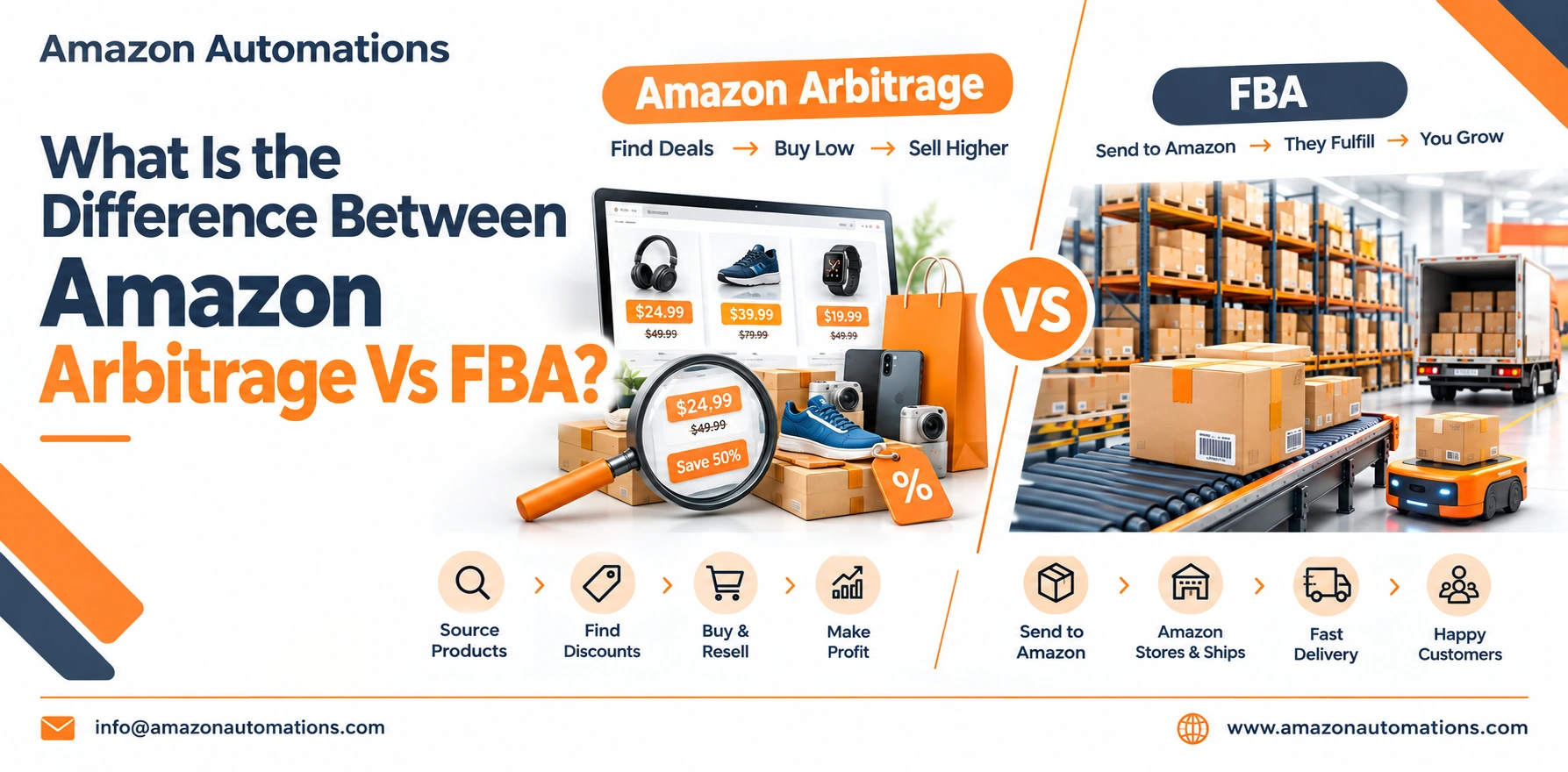
What Is the Difference Between Amazon Arbitrage Vs FBA?
You must think that selling products on Amazon is simple. You just find something cheap. Sell it for more. And make a profit. Easy, right? But it is not that simple. There are several ways sellers find products and get them into the hands of customers. You must hear of two very common terms. They are Amazon arbitrage and FBA.
Yes. They are related. But you must keep in mind that they are not the same thing. Amazon arbitrage is mainly about how you find products to sell. And FBA is basically about how Amazon stores and ships those products for you.
Let’s understand the Amazon arbitrage vs FBA difference.

What Is Amazon Arbitrage?
We will begin our discussion by understanding what Amazon arbitrage actually is. Amazon arbitrage is a simple business idea. You find products at a lower price from one store or website and then sell those products for a higher price on Amazon.
That is the basic idea behind arbitrage. You have to choose between the two common types of Amazon arbitrage. Retail or Online Arbitrage.
Retail arbitrage simply means finding discounted products in physical stores. Online arbitrage means finding discounted products on websites.
You just have to remember that arbitrage is a product sourcing method. It does not automatically tell you where to store your products or who ships them to your buyers.
Retail Arbitrage
Retail arbitrage involves visiting physical shops and looking for products that are being sold below their potential Amazon selling price.
You might find not only clearance toys and discounted electronics but also seasonal products and other items. Then you can compare the store price with the possible Amazon selling price. But do not forget the fees.
A product that looks profitable at first may not make money after you count all the expenses.
Online Arbitrage
Online arbitrage works in a similar way but happens on the internet. Instead of walking around stores, you search online shops for discounts. You then compare those prices with Amazon prices.
This can save you a lot of walking. You can search from your laptop or even your phone. But you still need to check not only shipping costs and Amazon fees but also the competition and the product’s sales potential.
Many people also compare online arbitrage vs. Amazon FBA. Online arbitrage is actually a way to source products. And FBA is basically a fulfillment service.
What Exactly Is FBA?
FBA is basically the short form of Fulfillment by Amazon. You send your products to Amazon. Amazon stores them in its fulfillment centers. Amazon packs the product and ships it to the customer when someone buys one.
It can also handle certain customer service and returns for FBA orders. Think of it like having a warehouse and shipping team without having to run the warehouse yourself. This is why FBA can be pretty useful for sellers who do not want boxes taking over their home or office.
How Does FBA Actually Work?
The process is fairly straightforward. First, you have to choose products to sell. Then you create your Amazon listings and prepare your inventory according to Amazon’s requirements. Then you must send your products to its fulfillment centers. Amazon handles the fulfillment process when a customer places an order.
And of course. FBA is not free. You need to consider not only storage and fulfillment fees but also referral fees and other possible costs. That means you should always calculate your expected profit before sending products to Amazon.
What Is Amazon FBA Automation?
Do you know what Amazon FBA Automation is? It basically refers to using not only software and tools but also third-party services to automate or manage parts of an FBA business.
Some services may help with tasks such as product research, inventory management, order processing, or other routine activities.
But you must keep in mind that “automation” does not mean the business runs itself. You still need to understand your products and monitor costs. You also have to follow the rules of Amazon and make sensible business decisions.
How Do the Two Differ? Amazon Arbitrage Vs FBA
Now we reach the part that causes the most confusion. Amazon arbitrage vs FBA is not really an either-or comparison. They describe two different parts of selling.
Arbitrage explains where or how you source products. FBA explains how those products are fulfilled after a customer places an order. In fact, you can use arbitrage and FBA together.
Here is a simple example.
You find a discounted product at a retail store. That is retail arbitrage. You buy several units and send them to Amazon. Amazon stores them and ships them when customers place orders. That is FBA.
Do you see the difference?
One is your sourcing method. The other is your fulfillment method.
Key Differences
This table will help you understand the Amazon arbitrage vs FBA difference in a better way:
| Feature | Amazon Arbitrage | Amazon FBA |
| What is it? | Product sourcing method | Fulfillment service |
| Main purpose | Find products at attractive prices | Store and ship products |
| Where does it happen? | Retail stores or websites | Amazon fulfillment centers |
| Can they be used together? | Yes | Yes |
| Main costs | Product cost, shipping, and related expenses | Storage, fulfillment, referral, and other applicable fees |
How Can Amazon Arbitrage and FBA Work Together?
You might be wondering whether the two can work together. Right? Yes. They can! You do not have to choose between arbitrage and FBA. You can simply use them at the same time.
Imagine you find a popular board game on sale online. You research the Amazon listing and check the numbers. You believe there is enough room for profit after accounting not only for the purchase price and shipping but also for Amazon fees and other costs.
You purchase the inventory and send it to Amazon. Amazon stores your products. It also handles the packing and shipping when customers buy them.
Your job is then focused more on finding suitable products and checking the numbers. You must also monitor the inventory and manage your business.
What Should Beginners Focus On?
If you are new to this world, do not try to learn everything in one afternoon. You must start with the basics. You can begin by understanding how Amazon fees work and product research. You should also learn how to calculate profit and read FBA requirements carefully.
Most importantly, learn how to check whether a product is actually worth buying. You may not know this, but just like Etsy Automation Services, you can also seek assistance with Amazon automation. This will make the process less tiring for beginners like you.
What is the difference between Amazon arbitrage vs FBA?
Amazon Arbitrage is basically a sourcing method where you buy discounted products from retail stores or websites and resell them for a profit. Amazon FBA is a logistics service where Amazon not only stores but also packs and ships your products.
Can you actually use Amazon arbitrage and FBA together?
Yes. You can definitely use Amazon arbitrage and FBA together. You can do that by buying discounted items from retail or online stores and sending them to an Amazon warehouse. Then Amazon not only stores but also packs and ships them for you.
Can beginners use Amazon FBA?
Yes. Beginners can surely use Amazon FBA. But they should first understand not only Amazon’s current seller requirements and fees but also its product restrictions and fulfillment rules.
Wrap Up!
Amazon arbitrage and FBA may sound like competing business models. But they actually solve different problems.
Arbitrage is about finding products to sell. And FBA is about storing and fulfilling those products.
You can source products through retail or online arbitrage and then use FBA to handle much of the fulfillment process.
The important part is doing your homework. You must check the numbers before buying inventory and understand the fees. You should also watch your competition. And never assume that every discounted product is a profitable opportunity.
The whole Amazon selling process becomes much easier once you understand these basics.

Jasmine Parker is a seasoned Amazon expert, decoding algorithms and scaling brands. By night, she channels that marketplace mastery into her premium content writing side hustle. Jasmine crafts high-converting, uniquely engaging blogs that break down the complexities of Amazon, Shopify, eBay, and TikTok automations. Combining real-world e-commerce authority with sharp, human-first storytelling, she creates helpful, insights-driven content that builds trust and turns casual readers into store owners.